Beyond ATS: How Official Skill Frameworks Are Changing Resume Screening in 2026
Keyword matching rewards whoever copies the job ad best. Framework-based matching asks a harder question: does this CV evidence the skills the occupation actually requires?
- ATS
- Skills-Based Hiring
- Job Frameworks
Keyword matching has an obvious weakness that everyone has now learned to exploit: it rewards whoever copies the job advert most faithfully. Paste the posting's vocabulary into your skills section and your match rate climbs, whether or not you can do the work.
That is not a flaw in any particular ATS. It is what string matching does. The interesting question is what screening looks like when the reference point stops being one employer's advert and becomes a published definition of the occupation.
What keyword matching actually measures

A conventional keyword match is a vocabulary comparison between two documents: the posting and your CV. It measures overlap, and overlap is a proxy — sometimes a decent one, often not.
Its failure modes are well known by now:
- Vocabulary mismatch fails good candidates. The posting says "GCP," your CV says "Google Cloud," and a naive matcher scores you down for a difference in wording. This is the single most common reason good CVs get rejected.
- Copying beats competence. The candidate who pastes the advert outranks the one who describes their real work in their own words.
- One employer's phrasing becomes the standard. If the posting was written badly, the filter inherits every one of its blind spots.
What a framework changes

Official occupational frameworks — O*NET in the US, ESCO in Europe — publish, for each occupation, the skills associated with it. Not one employer's wish list: a maintained, public reference. (How the two differ, and where they disagree, is worth ten minutes of your time.)
Matching against that reference is a different question. Instead of did this CV echo this advert, it asks does this CV evidence what this occupation requires. Three things improve:
- A stable reference point. The skill list does not change because a hiring manager rewrote the ad on a Friday afternoon.
- A meaningful gap list. "Missing: container orchestration" is actionable career information. "Missing keyword: Kubernetes" is an instruction to paste a word.
- Cross-language and cross-market comparability. ESCO publishes occupations in many languages, so the same occupation can be matched consistently for a candidate writing in Arabic and one writing in English.
It does not solve everything. Frameworks lag the market — as anyone who has looked for "DevOps Engineer" in either classification knows, since neither has an occupation by that name. And a skill list still cannot tell you whether someone is good, only whether the evidence is present. That is also the honest limit of the CV Fit Score: it sees presence, not mastery.
How both layers work together

In practice these are complementary, and it is worth being precise about which does what. The ATS score checker runs two distinct passes over your CV:
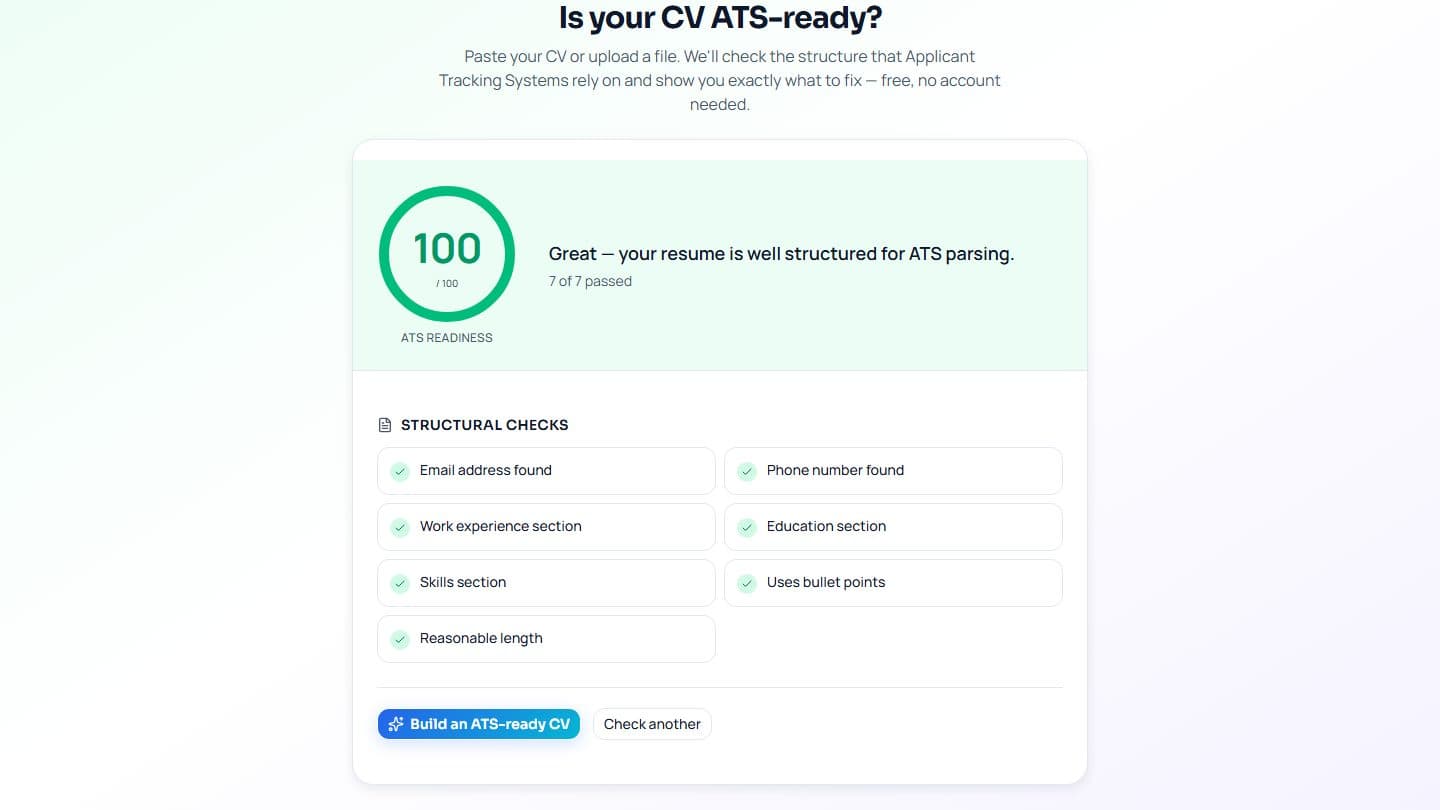
- A structural readiness check. Deterministic and rule-based: is there a findable email and phone number, are the standard section headings present, is the document a parseable length, are bullets used. It returns a 0–100 score with a specific hint for every failed check. No AI is involved, and it never invents a number.
- An optional role match. Pick your target role and it compares your CV text against the real ESCO essential skills for that occupation, reporting which are evidenced and which are missing. The skill labels come from the published classification, not from us — we only supply the search synonyms that let "CI/CD" and "continuous integration" both count as evidence.
The structural pass is the floor: if a parser cannot read your CV, nothing else matters. The role match is the part that tells you something about your candidacy rather than your formatting.
What this means for how you write

- Keep mirroring the posting's vocabulary — keyword matching has not disappeared, and it still runs first.
- But write to the occupation, not the advert. Cover the skills the role genuinely involves, including ones this particular posting forgot to mention.
- Treat a missing-skill list as a plan. If a framework says your target occupation requires something you cannot evidence, that is the highest-value thing to learn next.
- Describe evidence, not vocabulary. "Ran blue/green deploys across 12 services" survives both a keyword filter and a human reader. A bare skills list survives only the first.
- Check which occupation your title maps to. If you are unsure, the role glossary shows the official mapping — including where the closest match is only an approximation. Our index of 62 tech job titles is the fastest way in.
- Fix the structural basics first. A framework match cannot rescue a CV a parser cannot read — the most common formatting mistakes are still worth eliminating before anything else.
The direction of travel is straightforward: screening is moving from did you use the right words toward can you evidence the right skills. That is a harder standard to game, and — for anyone who has actually done the work — a considerably fairer one.