62 Tech Job Titles Defined: The Difference Between a Solutions Architect and a Systems Architect (and 60 Others)
A grouped index of the tech roles in our glossary, each linked to its official O*NET and ESCO definition — plus a plain answer to the architect-title confusion that trips up so many applications.
- Job Titles
- Job Frameworks
- Tech Careers
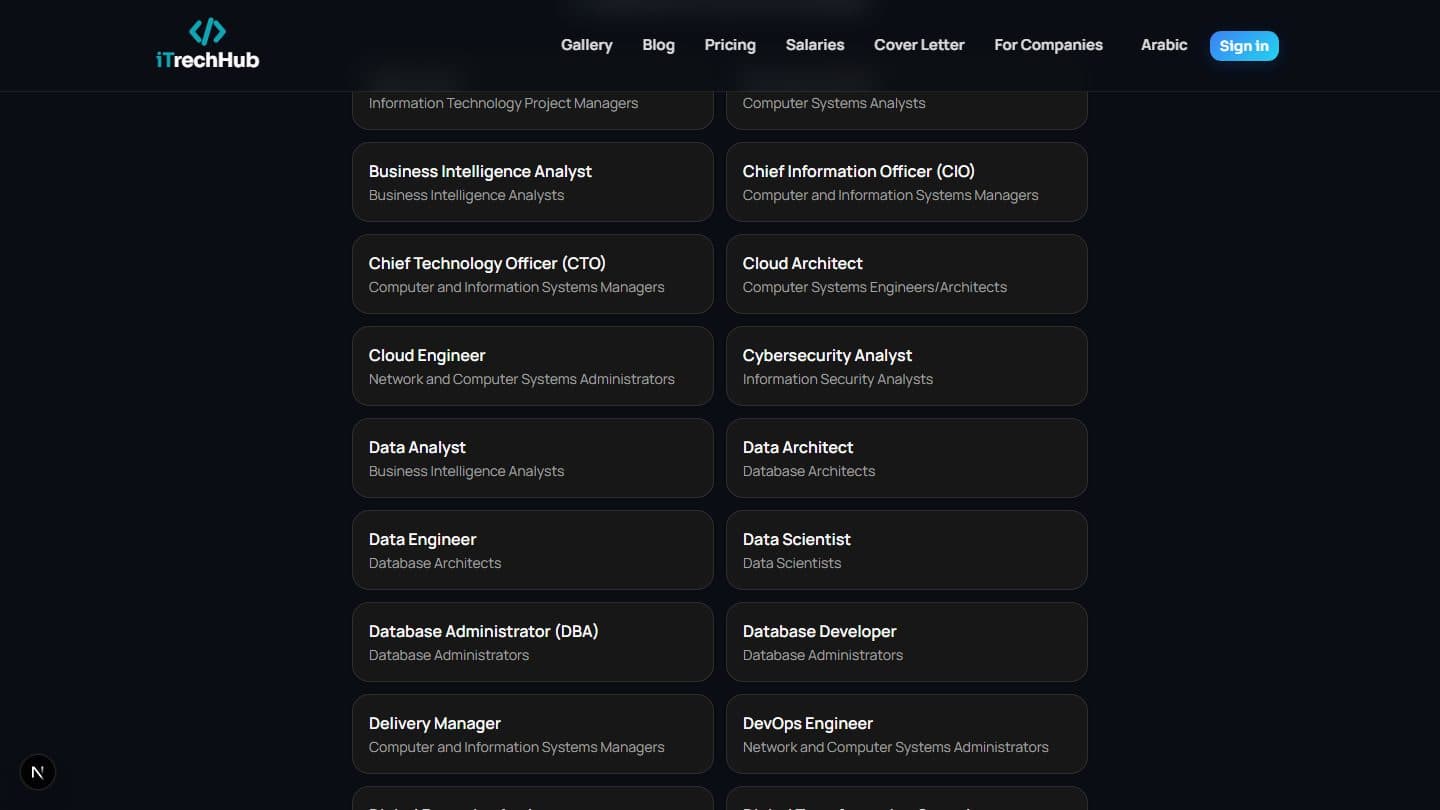
Tech job titles are not standardised. Employers invent them, and the same words mean different things at different companies — which is why so many applications go to roles that turn out to be something else entirely.
This is an index. Every role below links to its glossary entry, where you will find the official O*NET (US Department of Labor) and ESCO (European Commission) definitions side by side, the essential skills the frameworks associate with it, and links to the source records. If you want the background on those two frameworks first — and why they sometimes disagree — read O*NET vs ESCO.
First, the architect question

The most common title confusion in tech is the architect family, so let us take it head on.
A Solutions Architect designs how a specific business problem gets solved with technology: which systems, which integrations, which trade-offs, for one solution or programme. The scope is a solution.
A Systems Architect — and this is the important part — is not a standard occupation in either framework. It is a market title, used most often for someone who designs the internal structure of a particular system or platform. Depending on the employer, it maps closest to a Software Architect (structure of an application), an Enterprise Architect (structure across the organisation), or occasionally a Systems Analyst. If you see it in a posting, read the responsibilities rather than the title.
For the rest of the family: an Enterprise Architect works at organisation-wide scope, aligning technology strategy with business capability. A Software Architect owns the internal design of applications. Data, Cloud, Security, and Network Architects apply the same discipline within their domain.
This is a good illustration of the general rule: the title tells you less than the scope does.
Engineering & development

- Software Engineer
- Frontend Developer
- Full-Stack Developer
- Mobile Developer
- Embedded Systems Engineer
- Game Developer
- QA Engineer
Data & AI
- Data Scientist
- Machine Learning Engineer
- Data Engineer
- Data Analyst
- Business Intelligence Analyst
- Database Administrator (DBA)
- Database Developer
Architecture
- Enterprise Architect
- Solutions Architect
- Software Architect
- Data Architect
- Cloud Architect
- Security Architect
Networking
Security

- Cybersecurity Analyst
- Security Engineer
- SOC Analyst
- Penetration Tester
- GRC Analyst
- IT Auditor
- Digital Forensics Analyst
Infrastructure & operations
- Systems Administrator
- DevOps Engineer
- Cloud Engineer
- Site Reliability Engineer (SRE)
- IT Support Specialist
Product, delivery & project management

- IT Project Manager
- Program Manager
- PMO Analyst
- Scrum Master
- Agile Coach
- Delivery Manager
- Product Manager
- Product Owner
Analysis, consulting & leadership
- Business Analyst
- Systems Analyst
- IT Consultant
- Digital Transformation Consultant
- IT Manager
- Chief Technology Officer (CTO)
- Chief Information Officer (CIO)
Design & documentation
ERP: SAP, Oracle & Dynamics
- SAP Functional Consultant
- SAP FICO Consultant
- SAP MM Consultant
- SAP SD Consultant
- SAP HCM Consultant
- SAP ABAP Developer
- SAP BASIS Administrator
- Oracle ERP Consultant
- Microsoft Dynamics Consultant
- ERP Project Manager
How to use this list

- Read the definition before applying, not the title. If the posting's responsibilities do not match the framework definition, the employer means something specific — ask.
- Check where your title maps. Salary statistics and matching engines work by occupation, so knowing your standard occupation explains a lot of otherwise confusing data — see what really moves a tech salary, then check your own range in the salary calculator.
- Use the essential skills as a gap list. Each entry shows the skills the frameworks associate with the role — a concrete checklist for what to build or evidence next, and the basis of the CV Fit Score.
- Note the honesty flags. Where the closest official occupation is only an approximation rather than an exact match, the entry says so instead of pretending otherwise — DevOps Engineer is the clearest case.
- Expect screening to follow. Matching engines are moving from keyword overlap toward these published skill lists.
Browse the full role glossary, or check what a role's official skill list says about your CV with the ATS score checker.