CV Fit Score Explained: What We Actually Measure, and Why It Isn't Your ATS Score
Exactly what the CV Fit Score measures, where its skill lists come from, why it is not the same number as your ATS score, and what it deliberately does not try to judge.
- CV Fit Score
- ATS
- Tech Careers
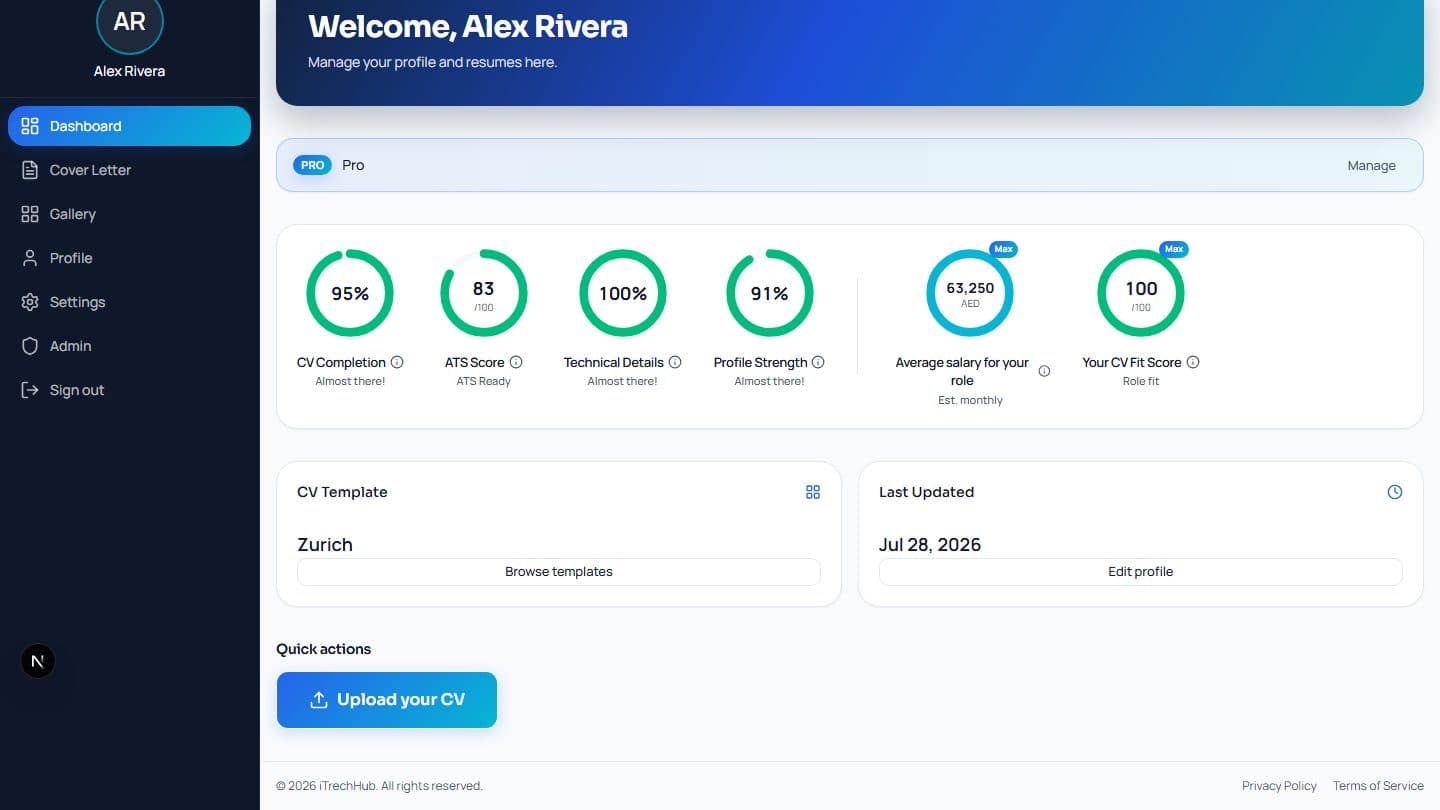
A score you do not understand is not useful — it is just a number telling you to feel good or bad. So this is a full explanation of what the CV Fit Score measures, where its inputs come from, and what it cannot tell you.
What it actually measures

The CV Fit Score answers one narrow question:
Of the key skills for your target role, what fraction does your profile actually evidence?
That is the whole calculation. Matched skills divided by total key skills, expressed as 0–100. If 6 of 10 key skills appear somewhere in your listed skills, you see 60.
It is deterministic and contains no AI. The same profile and the same target role always produce the same number. Nothing is generated, estimated, or inferred by a model, and the score is unit-tested against fixed inputs.
Where the skill lists come from

This is the part most scoring tools are vague about, so here it is plainly.
Our role taxonomy covers 62 tech roles, each mapped in the glossary to its official O*NET and ESCO occupation. But the CV Fit Score does not score you against a 62-way split of skill lists — it folds those roles onto 14 skill families (software, frontend, data engineering, DevOps, security, architecture, ERP, and so on), each with a curated list of around ten key skills.
That choice is deliberate, and it is a limitation worth stating: writing 62 genuinely distinct, defensible skill lists would fabricate a precision we do not have. Every SAP module — FICO, MM, ABAP and the rest — maps to the ERP family; Solutions, Cloud and Security Architect all map to the architecture family. The lists are ours — curated and maintained — not lifted from a framework.
Where the official framework skills are used directly is the role match inside the ATS score checker, which compares your CV text against the real ESCO essential skills published for that occupation. Two different tools, two different reference lists, both stated openly. If the distinction between our lists and the published ones matters to you, O*NET vs ESCO explains what the frameworks actually are, and Beyond ATS covers why screening is moving toward them.
What it reads

The score reads the skills recorded on your profile — your resume skills, your IT skills, your certification titles, and your tech-role tags — as one body of text, and looks for evidence of each key skill in it.
Matching is token-based with curated synonyms, so real writing counts: "CI/CD" and "continuous integration" both evidence the same skill, and the tokens are tuned to avoid false hits — "R" does not match inside "React."
Two consequences follow:
- Skills buried only in prose may not count. If Kubernetes appears in an experience bullet but nowhere in your skills, the matcher may not credit it. Listing it explicitly is not padding; it is making a real fact machine-readable.
- A role you have not set gives you nothing. With no target role there is no key-skill list, so the score is 0 by definition — that is a missing input, not a judgement.
Why it differs from your ATS score

People see an ATS score of 90 and a CV Fit Score of 43 and assume something is broken. Nothing is. They are different engines answering different questions from different inputs:
| ATS score | CV Fit Score | |
|---|---|---|
| Question | Can a parser read this CV? | Do these skills fit this role? |
| Input | The uploaded CV document text | The skills saved on your profile |
| Checks | Contact details, standard headings, length, bullets | Key-skill coverage for the role family |
| Reference | Structural rules (+ ESCO skills in the role match) | Curated family key-skill list |
A beautifully formatted CV for the wrong role scores high on one and low on the other. That contrast is the useful signal — it tells you whether your problem is formatting or positioning.
What it deliberately does not judge

- Skill depth. Listing Kubernetes counts the same whether you ran one cluster or fifty. The score sees presence, not mastery.
- Writing quality, seniority, or outcomes. Those are what your experience bullets and a human reader are for.
- Truthfulness. It cannot verify anything you list. Padding your skills to raise the number moves the score and nothing else — and it collapses in the first technical interview.
Used properly, the number is not the point. The missing list is: it names, specifically, the key skills for your target role that your profile does not evidence. That is a study plan and a CV to-do list at the same time.
The CV Fit Score is part of the Max plan's career insights, and the same skill coverage also adjusts your salary estimate within the market band — so the range reflects your actual profile rather than your job title alone. That is also why closing a skill gap is often worth more than arguing harder in a negotiation.