How Much Should You Ask For? A Region-by-Region Tech Salary Negotiation Guide
Benchmark before you negotiate, not after. How ranges shift by region and experience level, what to say when you're asked for a number first, and how to handle markets where the data is indicative.
- Salaries
- Negotiation
- Job Search
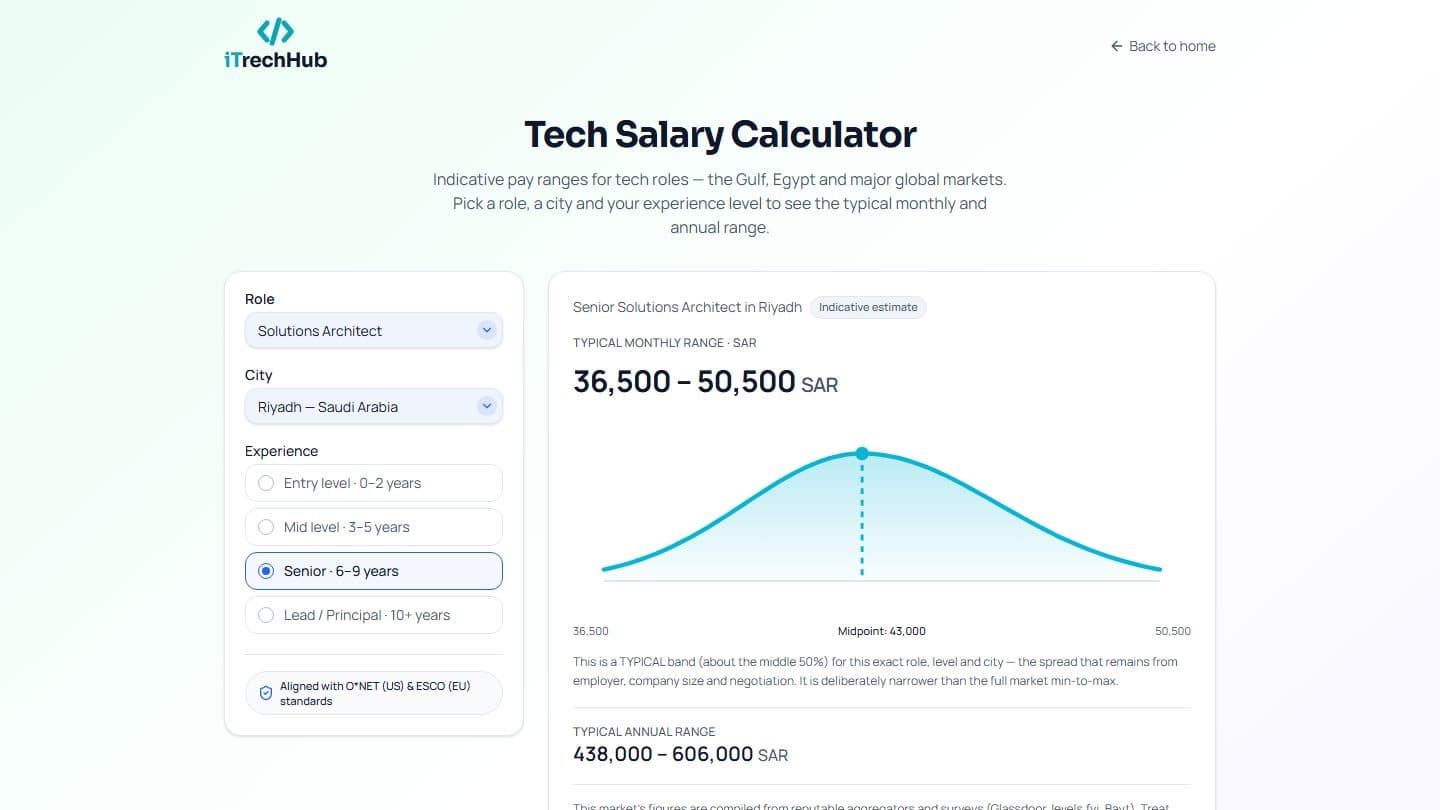
Most people lose a negotiation before it starts — by naming a number from a forum post, a friend's offer, or an article about a different city. The number is rarely the problem. The problem is that they cannot explain where it came from, so the first push-back collapses it.
Negotiation is mostly preparation. Here is the preparation.
Benchmark first, and benchmark narrowly

Before any salary conversation, you need a range you can defend for your role, your level, and your city — not a national average, and not the range for the title one rung above.
Run your role through the salary calculator and write down three things. If you have not read how those ranges are built, start there — it changes how hard you can lean on the number:
- The range for your level in your city.
- The range for one level up — this tells you how much room the ladder has.
- Which sources anchor that market, and when the figures were compiled.
That last point is what makes your number survive contact with a recruiter. "Around 20% more" is a wish. "The published range for this role and level in this city, from the market data I checked this month" is a position.
Where you sit inside the range is a skills question

A range is a distribution. Two candidates with identical titles land in different parts of it, and the deciding factor is usually evidenced skill coverage — not charisma, and not who asked more confidently.
Before you negotiate, check honestly how many of your target role's key skills your CV actually evidences. On the Max plan, the CV Fit Score does this against a curated key-skill list for your role family, and the salary estimate is adjusted by that same coverage — so the figure you see reflects your profile rather than just your title. If your coverage is thin, the highest-leverage move is often to close a gap rather than to argue harder.
You can also run the CV through the ATS score checker and pick your target role there — the skills it reports missing are the gaps a hiring manager is most likely to probe.
How regions differ

The negotiation is not the same conversation everywhere, because the package is not built the same way:
- Gulf markets. Base salary is frequently packaged with allowances, and tax treatment differs sharply from Europe. Negotiate the total, and ask explicitly how housing, transport, schooling, and annual flights are handled — these move the real value substantially.
- United States. At larger technology employers, a meaningful share of total compensation sits in equity and bonus. Negotiate the components separately, and ask about vesting and refresh policy. Several US jurisdictions now require a pay range in the posting — read it before you name a number.
- United Kingdom and Europe. More base-weighted. Pension, holiday allowance, and notice period carry real value. Collective agreements or published pay bands constrain the room in several markets — ask early whether a formal banding applies.
- Asia-Pacific. Extremely varied. Treat each market on its own terms; a regional average tells you almost nothing about a specific city.
When they ask for your number first

You will often be asked to name a figure before you have any information. Three workable responses, in order of preference:
- Redirect to their range. "What range is budgeted for this role at this level?" Many employers can answer directly, and in some jurisdictions they must.
- Give a researched range, not a point. Name the band you benchmarked and say where it came from.
- Defer to the offer stage. "I'd rather understand the scope first — I'm confident we can align once I know what the role covers."
What does not work is naming your current salary as the anchor. Your last employer's budget is not evidence about this role's market value, and in a number of jurisdictions employers are barred from asking.
Negotiating on indicative data

In markets without official occupation-level wage statistics — much of the Gulf, much of Asia — every published figure, including ours, is an indicative estimate compiled from aggregators and job ads. That does not make it useless; it makes it a starting position rather than a citation.
In those markets, lean harder on evidence you control: the scope of the role, the skills you demonstrably bring, and comparable offers you actually hold. Negotiating honestly about the quality of your evidence is far stronger than overstating it and being corrected.
Before the call

- You have a range for your exact role, level, and city, and you know its source and date.
- You know the range one level up.
- You can name three concrete outcomes from your recent work, with scale.
- You know which key skills for the role your CV evidences — and which it does not.
- You have decided your walk-away point before the conversation, not during it.
Start with the salary calculator, and check the role glossary if you are unsure which occupation your title maps to — negotiating for the wrong role definition is a common own goal.