Why Recruiters Are Starting to Ask for Your GitHub (Not Just Your CV)
Keyword lists stopped being a reliable filter, so hiring is shifting toward verifiable evidence. What a recruiter can and can't learn from your public code — and how to put that evidence on the CV itself.
- GitHub
- Skills-Based Hiring
- Job Search
For years, the tech CV was a keyword game. List the tools, match the posting, get through the filter. That game is ending — not because keywords stopped mattering, but because they stopped distinguishing anyone.
When every applicant can produce a flawless keyword list in seconds, a keyword list is no longer information. So hiring teams are doing the obvious thing: asking for evidence that is harder to manufacture.
Why the keyword filter broke

Three things happened at once:
- Generating a perfectly tailored CV became free. A posting asks for Kubernetes, Terraform, and Go; a matching skills section now appears instantly. The filter still passes candidates, but it no longer sorts them.
- Applicant volume rose sharply, because applying became just as cheap.
- The cost of a bad hire did not change at all. So the pressure to distinguish real capability moved further up the funnel.
The predictable response is a shift toward signals that are expensive to fake: work samples, structured technical assessment, and public contribution history. It is the same pressure pushing screening toward official skill frameworks rather than keyword overlap.
What a recruiter actually gets from your GitHub

It is worth being precise here, because both the enthusiasm and the cynicism about this are overstated.
A public profile genuinely supports:
- What you build in, weighted by volume. Languages measured by code you actually wrote across your own repositories, rather than claimed.
- Whether you sustain it. Activity across the last year separates ongoing practice from a single old burst.
- What kind of problems interest you, from what your repositories are.
It does not support:
- Code quality judgements at a glance. Nobody is reading your source in a six-second skim.
- Seniority. Contribution volume and seniority are barely correlated.
- A complete picture of your work. Most professional code is private, and always will be.
The useful mental model: public activity is corroborating evidence. It does not replace your experience section — it makes the claims in it harder to doubt.
The obvious failure mode

The moment a signal becomes valuable, people start gaming it — and hiring teams already know the patterns. Manufactured commit streaks, repositories full of tutorial output, forks presented as authored work: these are visible to anyone who looks for thirty seconds, and finding one costs you more credibility than an empty profile ever would.
Equally, "no public code" is not a red flag to a competent reviewer. If your best work sits behind an enterprise firewall, that is the normal case, not a deficiency. Say it plainly on the CV — a single honest line about private work under NDA reads as confidence, not as an excuse.
Put the evidence on the CV, not just in a link

This is where most candidates leave value on the table. A URL at the bottom of page two is not evidence a recruiter will act on; it is a request for them to do research they do not have time for.
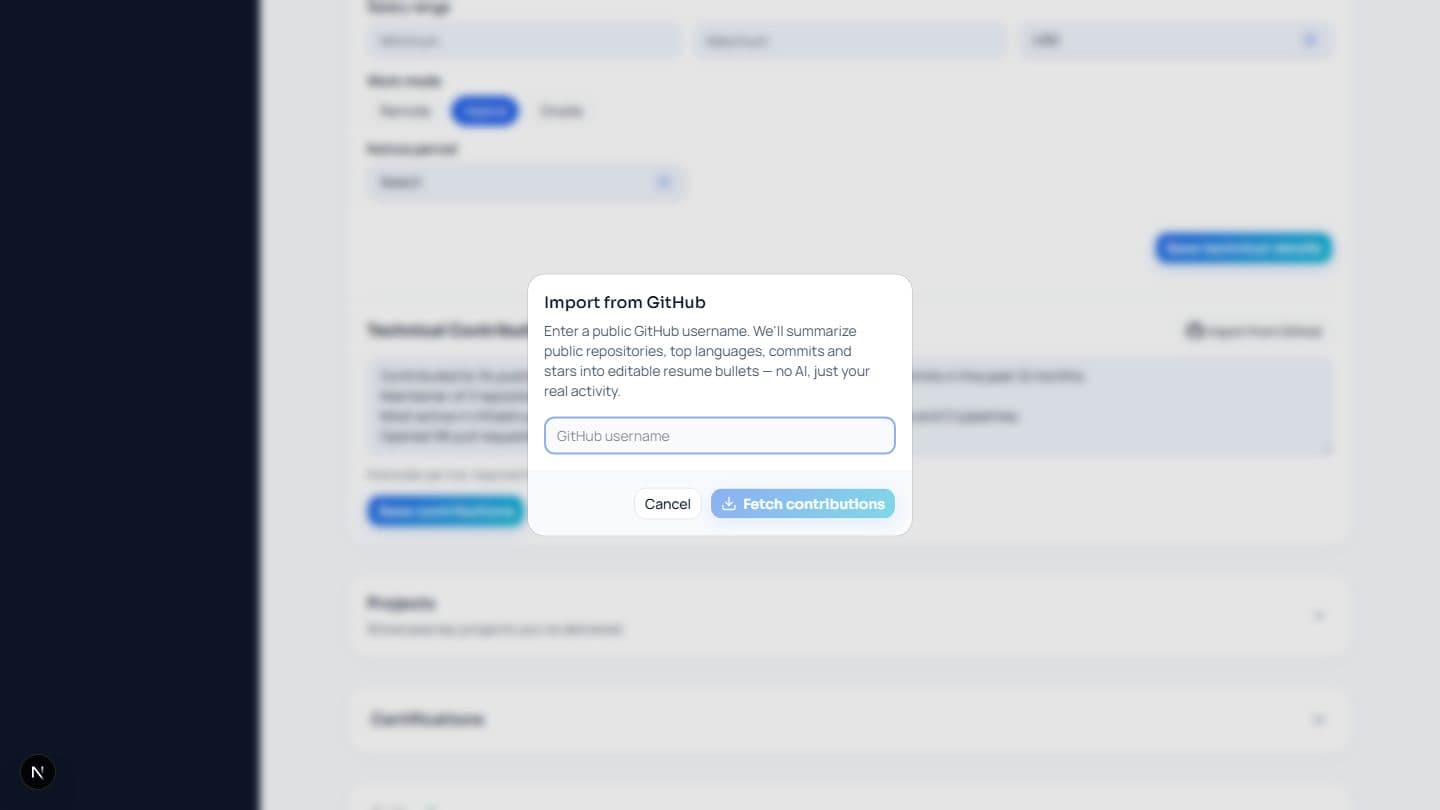
The GitHub import in the IT section of your profile reads a public account's repositories, top languages, commit activity, and stars, and turns them into editable resume bullets. It is a plain, deterministic read of public data — no AI, nothing inferred — and the bullets arrive as a draft you edit and approve before anything reaches your CV.
Then do the part that matters: rewrite each bullet so it names a language, a purpose, and a scale, and place it inside the relevant experience entry rather than in a section of its own. Our step-by-step guide to phrasing GitHub evidence works through the rewrite in detail, including what public activity honestly cannot show.
What this means for how you apply

- Assume the keyword list gets you considered, not shortlisted. Budget your effort accordingly.
- Lead with outcomes and scale in your experience bullets; that is the part a language model cannot invent for you truthfully.
- Make any public evidence legible on the CV itself — one or two strong lines, in plain text.
- Keep the profile link in your contact block as text, not as an icon, so parsers keep it.
- If you have no public code, say what you do have: private systems, scale, ownership.
The underlying shift is straightforward. Screening is moving from did you say the right words to can you show the work. The ATS score checker still matters — your CV must parse and cover the role's expected terms before a human ever sees it — but passing that filter is now the floor, not the finish line.