How to Turn Your GitHub Contributions Into a Resume Recruiters Actually Read
Your GitHub profile is evidence, but a link alone doesn't get read. Here's what an import can actually pull from public activity, how to phrase it as resume bullets, and what it honestly cannot show.
- GitHub
- CV Tips
- Tech Careers
Pasting a GitHub URL at the bottom of your CV is not evidence. It is a homework assignment for a recruiter who is reviewing a hundred applications and will not open it. (Why they increasingly ask for it anyway is a separate question — this post is the practical how.)
The value of your public activity is real — but only if you translate it into the CV itself, in plain, scannable text. Here is how to do that without exaggerating.
What public activity can actually tell someone

Read from the outside, a public GitHub account supports a narrow but genuinely useful set of claims:
- Languages you write, weighted by how much you write them. Measured by code volume across your own non-forked repositories — a far better signal than a self-declared skills list, because you cannot pad it.
- Sustained activity. Commit activity over the last year separates a steady contributor from an account with one burst three years ago.
- Scope of work. How many public repositories you own, and what they are.
- Reception. Stars and forks, which indicate that other people found something useful — with the caveat below.
That is the honest list. It does not include code quality, collaboration skill, or seniority. Anyone claiming to read those off a profile page is guessing.
Import it instead of typing it

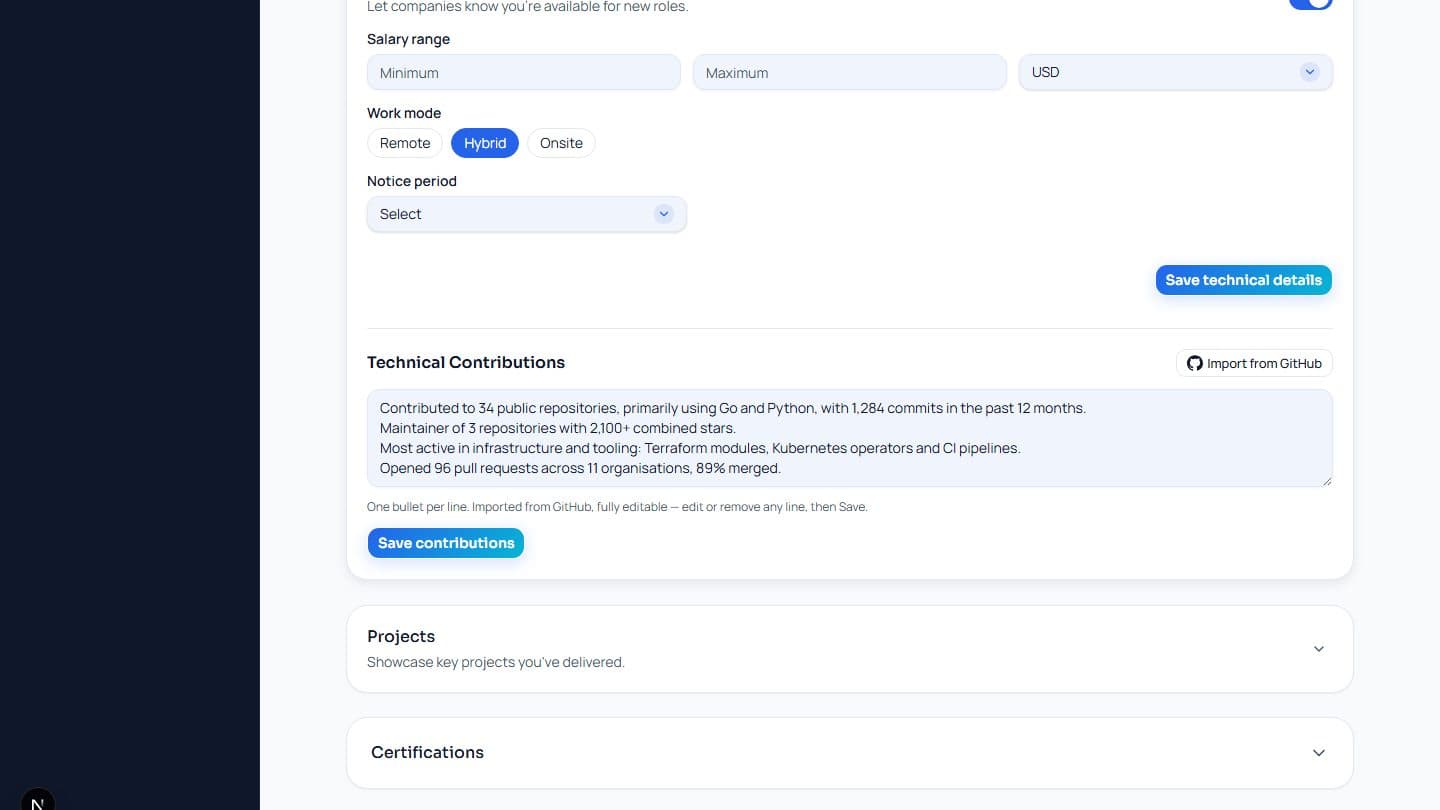
iTrechHub's GitHub import lives in the IT section of your profile. Enter a public GitHub username and it reads that account's public activity — repository count, top languages, commit activity, stars and forks — and turns it into editable resume bullets.
Two things worth knowing about how it works:
- There is no AI in this path. It is a direct, deterministic read of public GitHub data. Nothing is generated, inferred, or embellished — which is exactly what you want for a factual claim on a CV.
- The output is a draft you own. The bullets land in an editable field, one per line. Edit them, reorder them, delete the ones that do not help, then save. Nothing is written to your CV without you accepting it.
Phrase it like experience, not statistics

Imported bullets give you accurate raw material. The rewrite is where they become persuasive. A bare count is weak:
24 public repositories on GitHub.
Tie the same fact to a language, a purpose, and a timeframe:
Maintain 24 public repositories, primarily Python and Go, including a CLI tool for batch log parsing used by ~40 developers; active commits across the last 12 months.
Both are true. The second answers what a recruiter is actually asking: what do you build, in what, and do you keep at it?
A few phrasing rules that hold up:
- Lead with the language and the purpose, not the number.
- Name your most relevant repository, not your most starred one. Relevance to the job beats popularity.
- Say "public repositories" — it is precise, and it quietly signals that more work exists privately.
- Never imply that stars mean adoption. They mean visibility.
Be honest about what it misses

This matters for credibility, and it protects you in an interview:
- Private and enterprise work is invisible. GitHub's public API cannot see it, so it cannot be imported. If most of your strongest work is private, say so in a line of its own — that is a normal, expected situation for anyone who has worked in-house.
- Commit counts are not productivity. They reflect committing style as much as output. Use activity to show consistency, never to imply volume of value delivered.
- An empty year is not a gap in ability. Plenty of excellent engineers write no public code. Do not manufacture activity to fill a graph; recruiters who understand the signal also understand its absence.
- Forked repositories are excluded from the language calculation, deliberately — forking someone else's project is not evidence that you wrote it.
Where it belongs on the CV

Do not create a "GitHub" section floating on its own. Put the evidence where a reader is already looking:
- The strongest one or two bullets go inside your most relevant experience or projects entry.
- Languages join your skills section, phrased consistently with how the job description names them — the same discipline covered in our Cloud/DevOps keyword guide.
- The profile URL goes in your contact block, as plain text — never as an image or icon-only link, which many parsers drop entirely.
Once your bullets are in, run the result through the ATS score checker to confirm the whole CV still parses cleanly and covers the keywords the target role expects. Evidence only helps if the system can read it.