Cloud & DevOps Engineer CV Keywords That Get You Shortlisted
The keyword clusters recruiters and ATS actually scan for in Cloud and DevOps CVs — AWS, Kubernetes, Terraform, CI/CD — and how to phrase them with the depth that gets you shortlisted.
- DevOps
- Cloud
- Keywords
Cloud and DevOps roles attract hundreds of applicants, so most CVs are filtered by an Applicant Tracking System (ATS) long before a human reads them. The system parses your CV, matches it against the job description, and ranks you on how well your skills overlap with what the role asks for. Get the keywords wrong — or list tools with no context — and a strong engineer disappears into the rejection pile.
The good news: recruiters in this space look for a fairly predictable set of keyword clusters. This guide covers the ones that matter, and how to phrase them so they signal real depth instead of a tool inventory.
The core keyword clusters

Most Cloud/DevOps job descriptions cluster around a handful of themes. Make sure each cluster is represented in plain, scannable text:
- Cloud platforms: AWS, Azure, GCP — name the actual services (EC2, EKS, S3, IAM, Lambda; AKS, Azure DevOps; GKE, Cloud Run).
- Containers & orchestration: Docker, Kubernetes, Helm.
- Infrastructure as Code (IaC): Terraform, Ansible, CloudFormation, Pulumi.
- CI/CD & GitOps: CI/CD pipelines, GitHub Actions, GitLab CI, Jenkins, Argo CD, Flux.
- Observability: Prometheus, Grafana, the ELK stack, Datadog, OpenTelemetry.
Include both the acronym and its expansion once — "IaC (Infrastructure as Code)" — because a parser may be matching on either form.
Show depth, not a tool list

Listing twenty tools proves nothing. Recruiters want to see what you did with them and at what scale. Pair every headline tool with an outcome:
Used Kubernetes and Terraform on AWS.
versus
Ran a 40-node Kubernetes (EKS) cluster serving 3M requests/day, provisioned entirely with Terraform, cutting environment spin-up from 2 days to 20 minutes.
The second line still contains every keyword an ATS wants — Kubernetes, EKS, AWS, Terraform — but it also survives the recruiter's six-second skim because it carries scale, ownership, and a measurable result.
Phrase platform experience honestly

Don't claim all three clouds if you've only run one in production. Instead, signal depth where you have it and familiarity where you don't:
- Primary platform: "3 years running production workloads on AWS (EKS, RDS, IAM, CloudWatch)."
- Working knowledge: "Migrated services to Azure (AKS, Azure DevOps) during a 2024 consolidation."
- Exposure: "Familiar with GCP (GKE, Cloud Run) from internal tooling."
Mirror the job description. If the posting says "GCP" and "Terraform," use those exact words — not "Google Cloud" or "infrastructure automation." The parser matches on the posting's vocabulary, so meet it where it is, honestly.
Certifications that carry weight

Certifications are strong ATS keywords because job descriptions often name them explicitly. Spell out both the abbreviation and full name so either match hits:
- CKA — Certified Kubernetes Administrator
- AWS Certified Solutions Architect (SA – Associate or Professional)
- HashiCorp Certified: Terraform Associate
- Azure Administrator Associate (AZ-104)
- CKAD, AWS DevOps Engineer Professional, Google Professional Cloud Architect
List them in a dedicated Certifications section with the issuing body and year. If a cert is in progress, say so plainly rather than implying you hold it.
A pre-submit keyword checklist

Before you apply, run through this quick pass:
- Every cluster above is represented in plain text — nothing important lives inside an image or icon.
- Each headline tool is paired with a scale or outcome, not left as a bare noun.
- Keywords are pulled from the actual job description, used truthfully.
- Acronyms appear with their expansion at least once.
- Certifications are named exactly as the issuer writes them.
- Single-column layout — no tables or multi-column grids that break parsing.
Let iTrechHub check the match

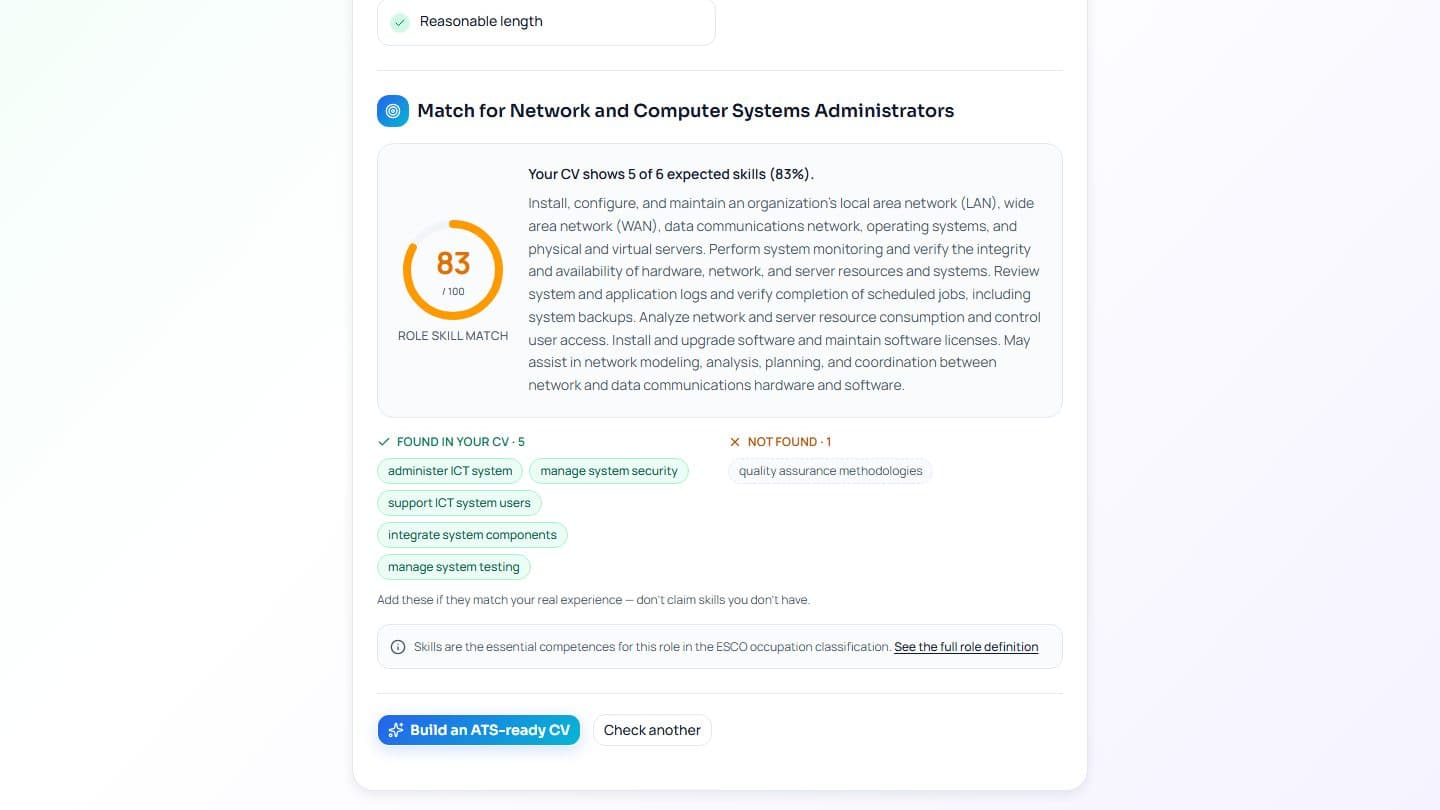
Once your CV is drafted, iTrechHub's ATS scoring checker compares it against a specific job description and flags the Cloud/DevOps keywords you're missing before you apply. Its ATS-safe templates keep everything single-column and cleanly parseable, and the AI rewrite/enhancer helps you turn a flat "used Terraform" into an outcome-driven bullet — a suggestion you review and accept, so the version a recruiter sees is genuinely yours.