Data Science & AI Engineer CV Guide
How to frame a data science, ML, or AI engineering CV — the skill clusters recruiters and ATS software look for, and how to prove impact with real metrics.
- Data Science
- AI Engineering
- CV Guide
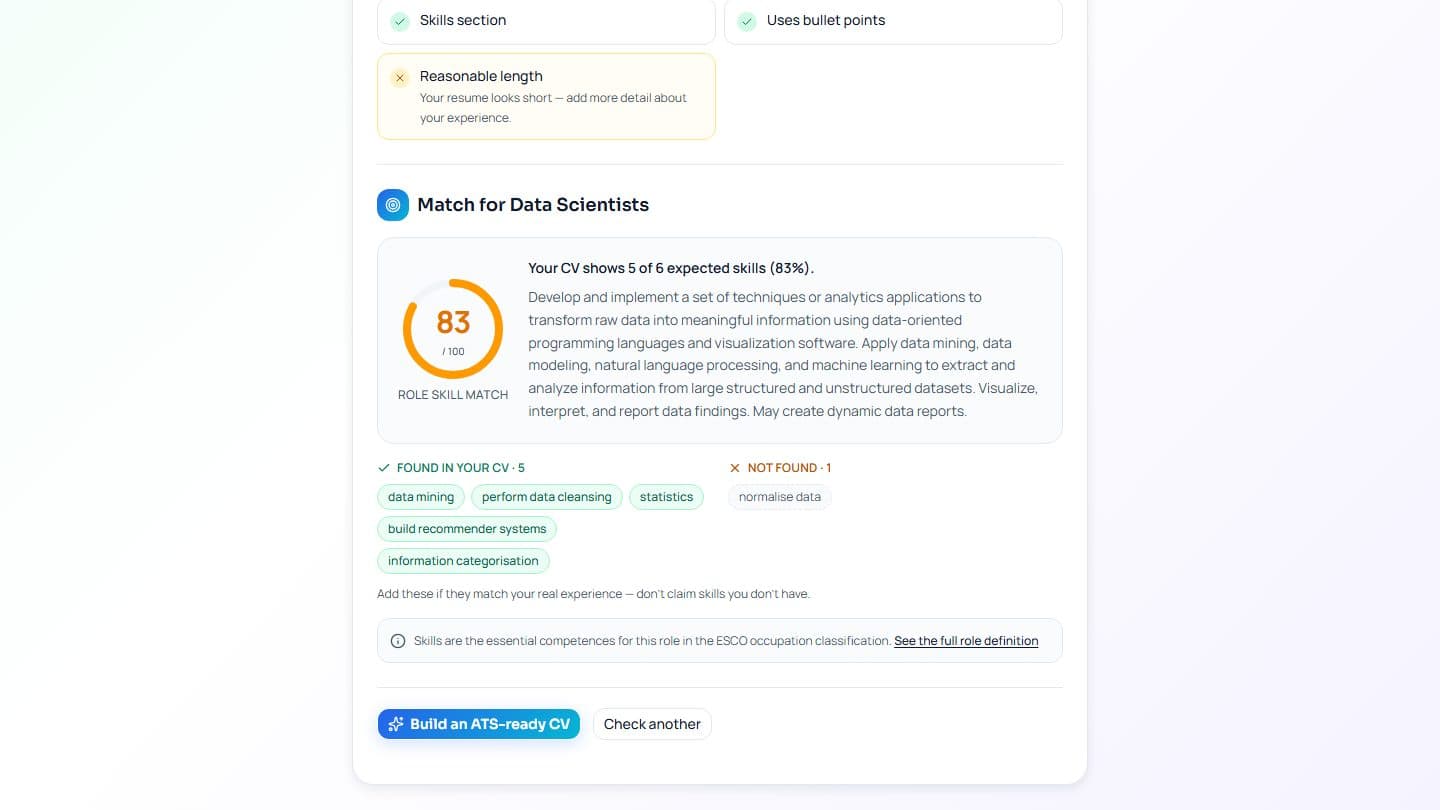
Data and AI roles are among the most competitive on the market, and they are also among the most misread by resume screeners. A brilliant data scientist can be filtered out because their CV lists twenty tools with no context, while a weaker candidate advances because they mirrored the job description and quantified two projects. The difference is rarely talent — it is framing.
This guide covers how to structure a CV for data science, machine-learning, and AI-engineering roles: which skill clusters to name, how to prove impact with numbers, and how to stay ATS-safe while doing it.
Name the right skill clusters

Recruiters and ATS software both scan for concrete, named technologies — not vague phrases like "machine learning expert." Group your stack into clusters and name the specifics:
- Languages & data: Python, SQL, pandas, NumPy, Spark for large-scale processing.
- Modeling: scikit-learn, PyTorch, TensorFlow, XGBoost, plus the methods you actually used — regression, gradient boosting, transformers.
- LLMs & modern AI: fine-tuning, RAG, prompt engineering, embeddings, and the frameworks behind them.
- MLOps & deployment: Docker, Kubernetes, model serving, CI/CD, experiment tracking (MLflow, Weights & Biases), feature stores.
Mirror the exact wording of the posting. If it says "PyTorch," write "PyTorch," not "deep-learning framework." Include both the acronym and its expansion once — "MLOps (machine-learning operations)."
Distinguish DS, ML engineer, and AI engineer

These titles overlap, but each weights the same skills differently. Tailor your summary and top bullets to the one you are targeting:
- Data Scientist — emphasize analysis, experimentation, and business impact: hypothesis testing, feature engineering, A/B tests, and models that changed a decision or a metric.
- ML Engineer — emphasize production: turning a notebook model into a reliable, monitored service, with latency, throughput, and reliability numbers.
- AI Engineer — emphasize applied LLM and generative systems: fine-tuning, RAG pipelines, evaluation, and integrating models into real products.
Leading with the wrong emphasis is a common, silent reason strong candidates get passed over.
Prove impact with metrics

Data roles live and die on measurable outcomes, yet many CVs describe activity instead of impact. Compare:
Built a model to predict customer churn.
versus
Built an XGBoost churn model that lifted precision from 0.71 to 0.86, cutting monthly churn by 12% and retaining ~$400K ARR.
Anchor every project to a number the reader cares about — model quality (accuracy, F1, AUC lift), scale (rows, features, requests/day), latency and cost (inference time cut, GPU spend reduced), or business value (revenue, retention, hours saved). Numbers survive both the ATS parse and the six-second human skim.
Show your portfolio and projects

For data and AI roles, evidence outside your job history carries real weight. Make it easy to find and easy to verify:
- GitHub — link a clean profile with a few well-documented repositories, not fifty abandoned forks.
- Kaggle — competition rankings or published notebooks signal practical modeling skill.
- Projects section — for each, state the problem, your approach, the stack, and the result in one or two lines.
- Certifications — cloud (AWS/GCP ML), deep-learning specializations, or relevant coursework, listed as plain text.
One end-to-end project you can explain deeply beats ten you touched briefly.
Keep it ATS-safe

None of the above matters if the parser cannot read it. Before you submit:
- Single column, no tables or text boxes — parsers scramble multi-column layouts.
- Contact details in the body, not the header, where many parsers ignore them.
- Skills as real, selectable text — never a graphic or a skills bar chart.
- Save as a text-based PDF, not an image export or scan.
- Every keyword sits inside a truthful accomplishment, not a stuffed list.
iTrechHub is built for exactly this. Its ATS scoring flags parsing and keyword gaps before you apply, its ATS-safe templates are single-column and clean by default, and its AI rewrite helps turn flat bullets into quantified, impact-driven lines you review and approve. Get the framing right and your real work finally gets seen.