ATS Resume Keywords for IT Jobs in 2026
Modern ATS reads meaning, not just words. Here is how Greenhouse, Lever, Workday, and iCIMS actually rank IT resumes — and how to use keywords honestly in 2026.
- ATS
- Keywords
- IT Careers
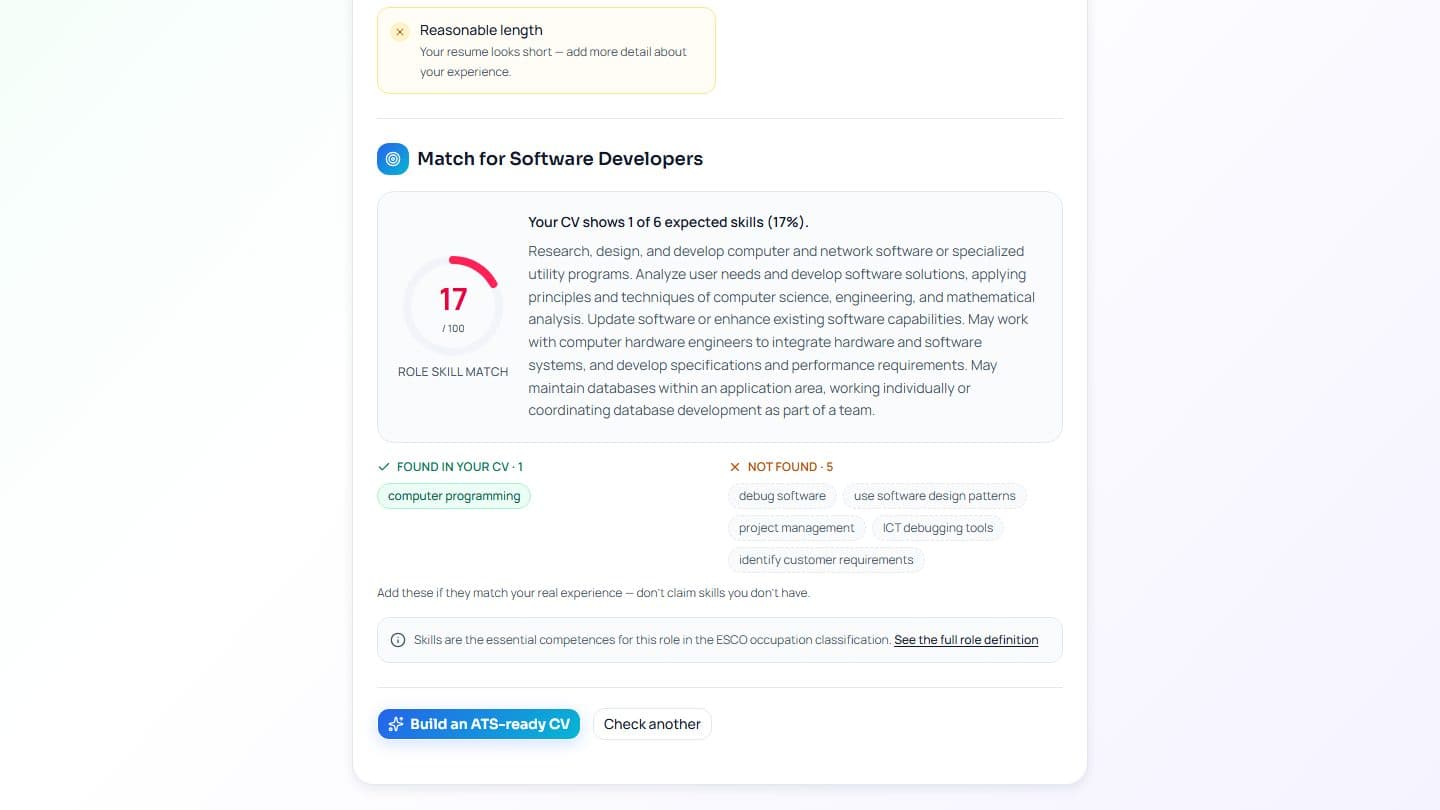
For years the advice was blunt: find the keywords in the job posting and repeat them until the machine is satisfied. In 2026 that advice is not just outdated — it can actively hurt you. Modern Applicant Tracking Systems no longer count word matches; they read context. They understand that "built a CI/CD pipeline" and "wrote a job description full of buzzwords" are very different signals, even when the same terms appear.
For IT roles, where the vocabulary is dense and every stack has its own dialect, getting this right is the difference between ranking near the top of the pile and never being seen. This guide covers how the major systems parse and rank, and how to place keywords so they help both the parser and the human who reads next.
How modern ATS actually ranks you

The big platforms behave differently under the hood, but the direction of travel is the same:
- Greenhouse and Lever lean on structured parsing and recruiter-defined scorecards. Your resume is turned into fields, and relevance is judged against the specific competencies the team is hiring for.
- Workday and iCIMS power huge enterprise pipelines and increasingly use semantic matching — they map your experience to a role profile by meaning, so "K8s," "Kubernetes," and "container orchestration" can register as related rather than as three separate misses.
The practical takeaway: repetition no longer buys you rank. Relevance in context does. A term used once inside a real accomplishment outperforms the same term listed five times.
Why context beats repetition

Semantic parsers weigh where and how a term appears. A skill named in a bullet that also states a technology, an action, and an outcome carries far more weight than a bare word in a list.
Compare a stuffed line with a contextual one:
Skilled in AWS, AWS cloud, Amazon Web Services, AWS EC2, AWS S3, AWS Lambda.
versus
Migrated a monolith to AWS (EC2, S3, Lambda), cutting infrastructure cost 32% and deploy time from 40 to 6 minutes.
The second line names the same technologies once, but ties them to responsibility and results — exactly the signal a modern ranker is built to reward.
Mirror the job description — honestly

Mirroring means using the same terms the posting uses, only where they are genuinely true of you:
- Read the posting and note its exact wording — "observability," not "monitoring," if that is what they wrote.
- Match their level of specificity. If they say "Terraform," write "Terraform," not just "infrastructure as code."
- Spell out acronym and expansion once: "SRE (Site Reliability Engineering)," "IaC (infrastructure as code)." Parsers and recruiters may search for either form.
- Never claim a tool you have not used. Semantic systems increasingly cross-check keywords against the surrounding evidence, and interviews expose the rest.
The goal is a truthful overlap, not a mirror image.
Role-family keyword clusters for IT

Keywords travel in families. Recruiters and parsers expect to see a coherent cluster for your role, not a random scatter. A few examples:
- DevOps / SRE: CI/CD, Docker, Kubernetes, Terraform, Ansible, Prometheus, Grafana, incident response, SLOs.
- Cloud Engineer: AWS, Azure, GCP, IAM, VPC, serverless, cost optimization, IaC.
- Backend Engineer: REST, gRPC, PostgreSQL, Redis, message queues, caching, API design, microservices.
- Data Engineer: Spark, Airflow, dbt, Snowflake, ETL/ELT, data modeling, streaming.
- Security / IT: SIEM, IAM, zero trust, vulnerability management, SOC 2, ISO 27001.
Pick the cluster that matches the target role and let your experience prove each term.
Where keywords actually belong

Keywords earn their rank in two places — and both should be honest:
- A dedicated skills section: a plain, scannable list of technologies. This gives the parser a clean, structured field to read.
- Inside real accomplishments: the same technologies, shown in action within your experience bullets. This is where context lives, and where semantic rankers assign the most weight.
Avoid every version of the old trick: no keyword walls, no invisible white text, no hidden term dumps in the footer. Modern parsers detect them, and some ATS flag the resume outright. A stuffed resume that slips past the parser still meets a human who can tell in seconds.
Putting it to work

Strong keyword strategy in 2026 is simple to state: mirror the posting honestly, use each term in context, and keep the structure clean enough to parse. That is easier to check than to guess. iTrechHub's ATS checker scores your resume against a specific job description and flags weak or missing terms, its single-column ATS-safe templates keep the structure parseable by default, and the AI rewrite helps you fold real keywords into accomplishment-driven bullets — so the version a recruiter ranks is the honest one you meant to send.